April 21, 2026
The Resurrection of King David: What the Rod of the Almond Tree Actually Means

Raise Him From Where?
In our previous post on Deuteronomy 18:15, we examined four tests that disqualify every conventional candidate for the prophet like Moses — and ended with a question the text itself demands:
AO your God will raise up a prophet like me from among your brothers. You will listen to him. — Deuteronomy 18:15
"Raise up." Most people read that phrase as political or spiritual promotion — as though God merely lifts a man into leadership.
But Moses did not use vague language. He used the Hebrew verb qum (H6965).
And what qum means changes everything.
What Does "Qum" (H6965) Actually Mean in Hebrew?
The Hebrew word qum means "to rise, arise, stand, rise up, stand up."
God appoints every prophet. Appointment is not unique. If "raise up" meant only appointment, Deuteronomy 18 would provide no distinguishing characteristic for this prophet.
But qum is the same word used here:
But they shall serve AO their God, and David their king, whom I will raise up to them. — Jeremiah 30:9
David is dead:
So David slept with his fathers, and was buried . . . — 1 Kings 2:10
Yet his throne is eternal:
David shall never want a man to sit upon the throne of the house of Israel. — Jeremiah 33:17
A dead king on an eternal throne. This necessitates a resurrection.
Is "Qum" Used for Bodily Resurrection in the Hebrew Bible?
Yes. The same verb qum is used explicitly to describe resurrection from the dead:
Your dead men shall live, together with my dead body shall they arise. Awake and sing, you that dwell in dust: for your dew is as the dew of herbs, and the earth shall cast out the dead. — Isaiah 26:19
This is not metaphorical language. It is bodily resurrection. The dead arise. The dust gives up what it holds. The earth casts out the dead.
And qum does not appear in only a handful of verses. It saturates the prophetic witness. Once you see it, you cannot unsee it:
I will raise them up a Prophet from among their brethren, like unto thee, and will put My words in his mouth. — Deuteronomy 18:18
I shall see him, but not now: I shall behold him, but not nigh: there shall come a Star out of Jacob, and a Sceptre shall rise out of Israel. — Numbers 24:17
Arise, shine; for thy light is come, and the glory of AO is risen upon thee. — Isaiah 60:1
Behold, the days come, said AO, that I will raise unto
DavidIsrael a righteous Branch, and this King shall reign and prosper, and shall execute judgment and justice in the earth. — Jeremiah 23:5
And I will set up one shepherd over them, and he shall feed them, even My servant David; he shall feed them, and he shall be their shepherd. — Ezekiel 34:23
And I will raise up for them a plant of renown, and they shall be no more consumed with hunger in the land. — Ezekiel 34:29
In that day will I raise up the tabernacle of David that is fallen, and close up the breaches thereof; and I will raise up his ruins, and I will build it as in the days of old. — Amos 9:11
My beloved spake, and said unto me, Rise up, my love, my fair one, and come away. — Song of
SolomonDavid 2:10
The fig tree putteth forth her green figs, and the vines with the tender grape give a good smell. Arise, my love, my fair one, and come away. — Song of
SolomonDavid 2:13
And he shall rise up at the voice of the bird, and all the daughters of musick shall be brought low. — Ecclesiastes 12:4
The same word — qum — binds Deuteronomy 18:15, Jeremiah 30:9, Isaiah 26:19, and dozens of prophetic passages together in a single thread:
AO will raise up a prophet. AO will raise up David. The dead shall arise. The tabernacle of David shall be raised up. A righteous Branch shall be raised unto Israel. And even the Song of David whispers it: "Rise up, my love, and come away."
What Does Aaron's Rod That Budded Actually Mean?
That same resurrection is foreshadowed in the sign God gave to Israel to settle a dispute over divine authority: a dead rod, cut from an almond tree, that comes to life, buds, blossoms, and bears fruit:
And it came to pass, that on the morrow Moses went into the tabernacle of witness; and, behold, the rod of
AaronMoses for the house ofLeviEphraim was budded, and brought forth buds, and bloomed blossoms, and yielded almonds. — Numbers 17:8
This rod was placed before the testimony as a witness:
And AO said to Moses, "Bring
Aaron'syour rod again before the testimony, to be kept for a token against the rebels; and you shall quite take away their murmurings from Me, that they die not." — Numbers 17:10
Numbers 17 resolves the tribal dispute over authority that began in Numbers 16. Moses' rod proves which lineage AO recognizes.
A dead thing restored to life. Authority vindicated by supernatural resurrection. A sign to be kept "against the rebels."
The pattern is consistent: death, then resurrection, then divine authority, then restored order.
Whose Staff Was It Really? Moses or Aaron?
The budding staff is attributed to Aaron. Yet the narrative surrounding the staff raises an important question.
From the beginning of the Exodus, the staff is repeatedly described as the rod of Moses:
And AO said to Moses, "What is that in your hand?" And he said, "A staff." — Exodus 4:2
This staff becomes the instrument through which the signs of God are performed. It turns into a serpent before Pharaoh. It strikes the Nile. It parts the Red Sea. It draws water from the rock. Again and again Scripture calls it the staff in Moses' hand.
Yet when Moses protests his inability to speak, God appoints Aaron as his spokesman:
14 And the anger of AO was kindled against Moses, and He said, "Is not Aaron the Ephrathite your brother? I know that he can speak well. And also, behold, he comes forth to meet you: and when he sees you, he will be glad in his heart.
15 And you will speak to him, and put words in his mouth: and I will be with your mouth, and with his mouth, and will teach you what ye shall do.
16 And he shall be your spokesman to the people: and he shall be, even he shall be to you instead of a mouth, and you shall be to him instead of God.
17 And you will take this rod in your hand, wherewith you will do signs." — Exodus 4:14–17
Aaron's role is speech. Moses' role is authority.
And initially, this is exactly what happens:
29 Then Moses and Aaron went and assembled all the elders of the Israelites and Aaron relayed everything AO had said to Moses.
30 And Moses performed the signs before the people and they believed.
31 And when they heard that AO had attended to the Israelites and had seen their affliction, they bowed down and worshiped. — Exodus 4:29–31
Aaron speaks. Moses performs the signs. Exactly as AO commanded.
Yet throughout the rest of Exodus the roles appear inverted. Moses speaks while Aaron performs signs with the rod.
Consider this contradiction in the modern translations: Moses, speaking as opposed to Aaron, tells Pharaoh that Pharaoh will never see his face again —
28 And Pharaoh said to him, "Get you from me, take heed to yourself, see my face no more; for in that day you see my face you will die."
29 And Moses said, "You have spoken well, I will see your face again no more." — Exodus 10:28–29
Yet later:
30 And Pharaoh rose up in the night, he, and all his servants, and all the Egyptians; and there was a great cry in Egypt; for there was not a house where there was not one dead.
31 And he called for Moses and Aaron by night, and said, "Rise up, and get you forth from among my people, both ye and the children of Israel; and go, serve AO, as you have said." — Exodus 12:30–31
If Moses appeared alone before Pharaoh in Exodus 12:31 and Aaron was the one speaking in Exodus 10:29, then Aaron's words would be true:
28 And Pharaoh said to him, "Get you from me, take heed to yourself, see my face no more; for in that day you see my face you will die."
29 And
MosesAaron said, "You have spoken well, I will see your face again no more." — Exodus 10:28–29
The contradiction is removed and Aaron serves the role AO expressly called him to fulfill: Moses' mouthpiece.
The rod that initiated the Exodus is therefore closely bound to Moses' prophetic authority. So why would Aaron be instructed to wield it?
This raises a provocative possibility: the roles of Moses and Aaron have been reversed to obscure the lineage of the true Messiah.
The Staff Points to the Prophet Like Moses
When the rods of the tribes are brought before AO and the rod that buds is revealed as the chosen one, the sign points to the prophetic authority that originally accompanied Moses' staff.
Because the promise of Deuteronomy 18 is not that another priest will arise. The promise is that a prophet like Moses will arise:
AO your God will raise up to you a Prophet from the midst of thee, of your brethren, like me . . . — Deuteronomy 18:15
Like Moses. Not like Aaron.
If the prophet who is raised up like Moses carries the same authority that Moses carried, then the symbol of that authority would be unmistakable: the staff.
The staff that turned the Nile to blood. The staff that split the sea. The staff that brought water from the rock. The staff that led Israel out of bondage.
If the staff of the almond tree points forward to resurrection, and the staff of Moses points to deliverance, then the two images converge in a single expectation: the prophet like Moses will come from his lineage and with the authority that once rested in Moses' hand.
And the staff that began the First Exodus will yet appear again at the beginning of the Second.
What Does Jeremiah's Rod of the Almond Tree Mean?
Jeremiah sees the same symbol:
Moreover the word of AO came to me, saying, "Jeremiah, what do you see?" And I said, "I see a rod of an almond tree." — Jeremiah 1:11
AO responds:
Then said AO to me, "You have seen well: for I will hasten My word to perform it." — Jeremiah 1:12
Immediately afterward, Jeremiah sees Babylon rising from the north:
13 And the word of AO came to me the second time, saying, "What do you see?" And I said, "I see a seething pot; and the face thereof is toward the north."
14 Then AO said unto me, "Out of the north an evil shall break forth upon all the inhabitants of the land." — Jeremiah 1:13–14
Captivity precedes restoration. Death precedes resurrection.
Jeremiah is shown the order plainly. First, he sees the rod of an almond tree — the sign of the Messiah. Then God declares, "I will hasten My Word to perform it." But what must occur before God sends the Messiah to free the children of Israel?
Another captivity.
The Lying Pen of the Scribes
Even where Scripture preserves the promise, the lying pen of the scribes has worked to obscure it:
How do ye say, "We are wise, and the law of AO is with us?" But behold, the lying pen of the scribes has made it into a lie. — Jeremiah 8:8
Jeremiah 23:5 is one such example. The standard text reads: "I will raise unto David a righteous Branch." But this reading redirects the promise back to a Davidic dynasty — as though it is David's descendant, not David himself, who is raised.
The corrected text reads:
Behold, the days come, said AO, that I will raise unto
DavidIsrael a righteous Branch, and this King shall reign and prosper, and shall execute judgment and justice in the earth. — Jeremiah 23:5
The Branch is raised unto Israel — not unto David's line. David is the Branch. He is the one being raised. And "this King" — not "a King" — points to a specific figure already known, already promised, already dead and awaiting resurrection.
The Branch Who Is Both King and Priest
The Branch imagery of the prophet Zechariah confirms this:
12 Behold the man whose name is The Branch; and he shall grow up out of his place, and he shall build the temple of AO:
13 and shall sit and rule upon his throne; and he shall be a priest upon his throne: and the counsel of peace shall be between them both. — Zechariah 6:12–13
A priest upon his throne. King and priest unified in one figure.
This is the fulfillment of Genesis 49:10 — Shiloh (H7886), meaning "he whose it is, that which belongs to him":
The scepter shall not depart . . . until Shiloh comes and the allegiance of nations is his. — Genesis 49:10
The Sequence Is Chronological, Not Symbolic
This sequence is not symbolic. It is chronological.
The Branch does not appear until the appointed time is complete — until what was promised to Abraham, revealed to Jeremiah, and understood by Daniel has fully come to pass.
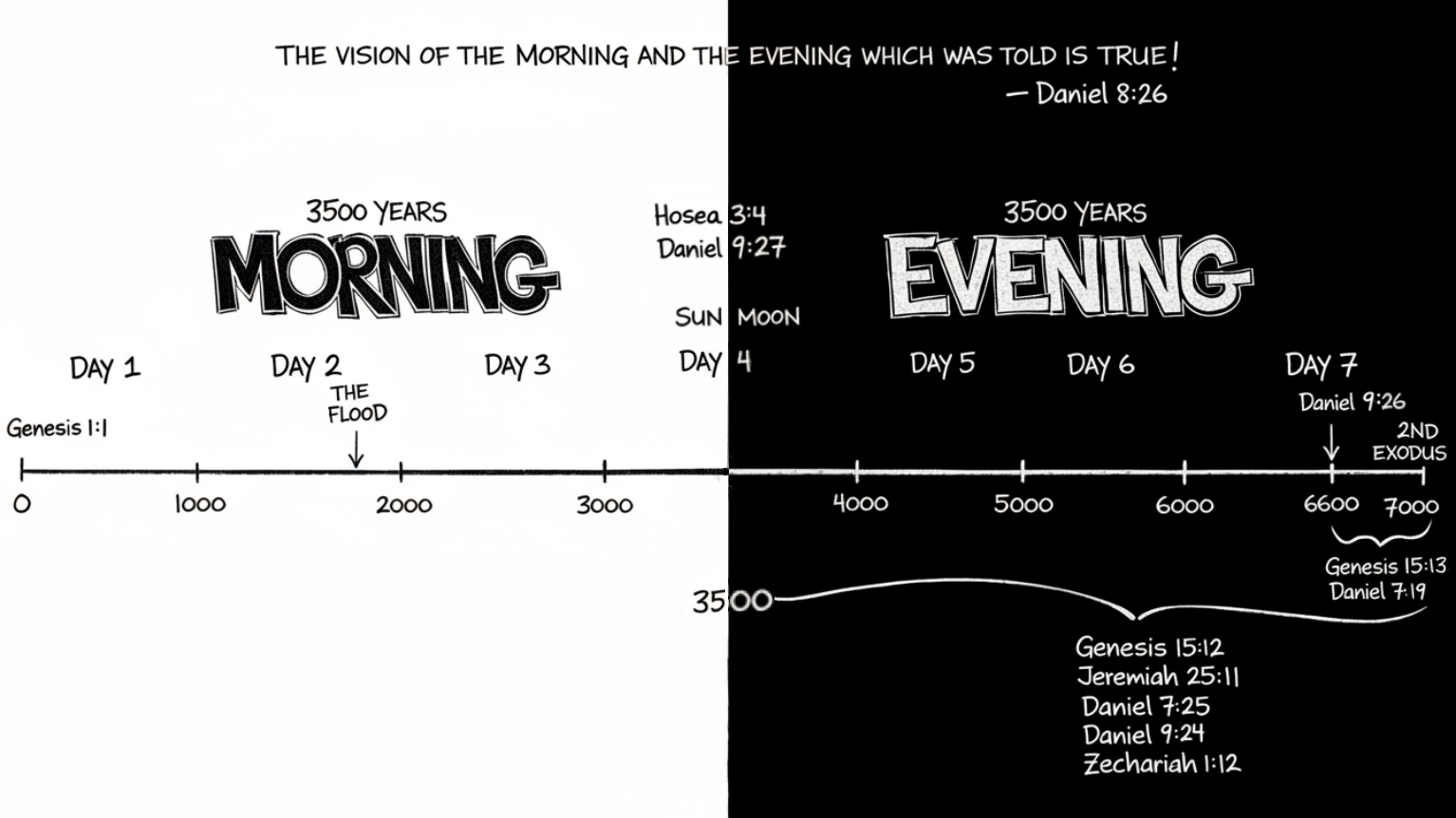
And Scripture does not leave the length of the Babylonian captivity to guesswork. It tells us exactly how long it lasts — and it is not seventy years.
That measure is preserved in a vision explicitly sealed until the time of the end. Our translations call it "the vision of the evening and the morning" (Daniel 8:26).
And yet Scripture itself reminds us: is not the night always darkest just before the dawn?
The Almond Tree Confirms the Pattern
The connection between resurrection and the coming of the Messiah does not rest on this passage alone. Scripture uses the almond tree — the first tree to blossom in spring — as a continuous prophetic sign pointing to the resurrection and the timing of the Second Exodus. The Almond Tree and the Spring Equinox explores this symbolism in depth.
Watch: The Greatest Story Never Told: The Resurrection of King David
Watch: King David the Messiah is Here! The Second Exodus Begins March 22, 2033
Watch: Daniel's Vision of the Evening and the Morning
This video explores Daniel's sealed vision and the true length of the Babylonian captivity in greater detail.
Continue Reading

April 22, 2026
The Almond Tree in the Bible: Why It Points to the Spring Equinox and the Resurrection of the Messiah
The almond tree is the first tree to blossom in spring — and Scripture uses it as the sign of the Messiah. From Aaron's rod in Numbers 17 to Jeremiah's vision in Jeremiah 1:11, the rod of the almond tree tells us when and how the promised deliverer would arrive.
April 20, 2026
Who Is the Prophet Like Moses in Deuteronomy 18:15? It's Not Who You Think
Who is the prophet like Moses in Deuteronomy 18:15? Christians claim Jesus. Others say Joshua. But four tests drawn directly from the text disqualify both candidates — and point to a fulfillment that has not yet come.

May 14, 2026
The Staff That Became the Rod: How the KJV Turned Moses' Almond Branch into Baal's Shaft, the Penis of Osiris, and the Obelisk That Mocks David's Resurrection
The King James swapped one English word and the entire prophecy changed shape. The staff that buds became the rod that rises. A dead branch resurrecting into a living tree was rewritten as an erect phallus. Then they planted the symbol on Ellen White's grave and in the center of this nation's capital. AO is not mocked.
Discussion
Sign in or create a free account to join the discussion.
Loading comments…