May 5, 2026
The Twin Flames: Flame 1 — The Priests of Baal
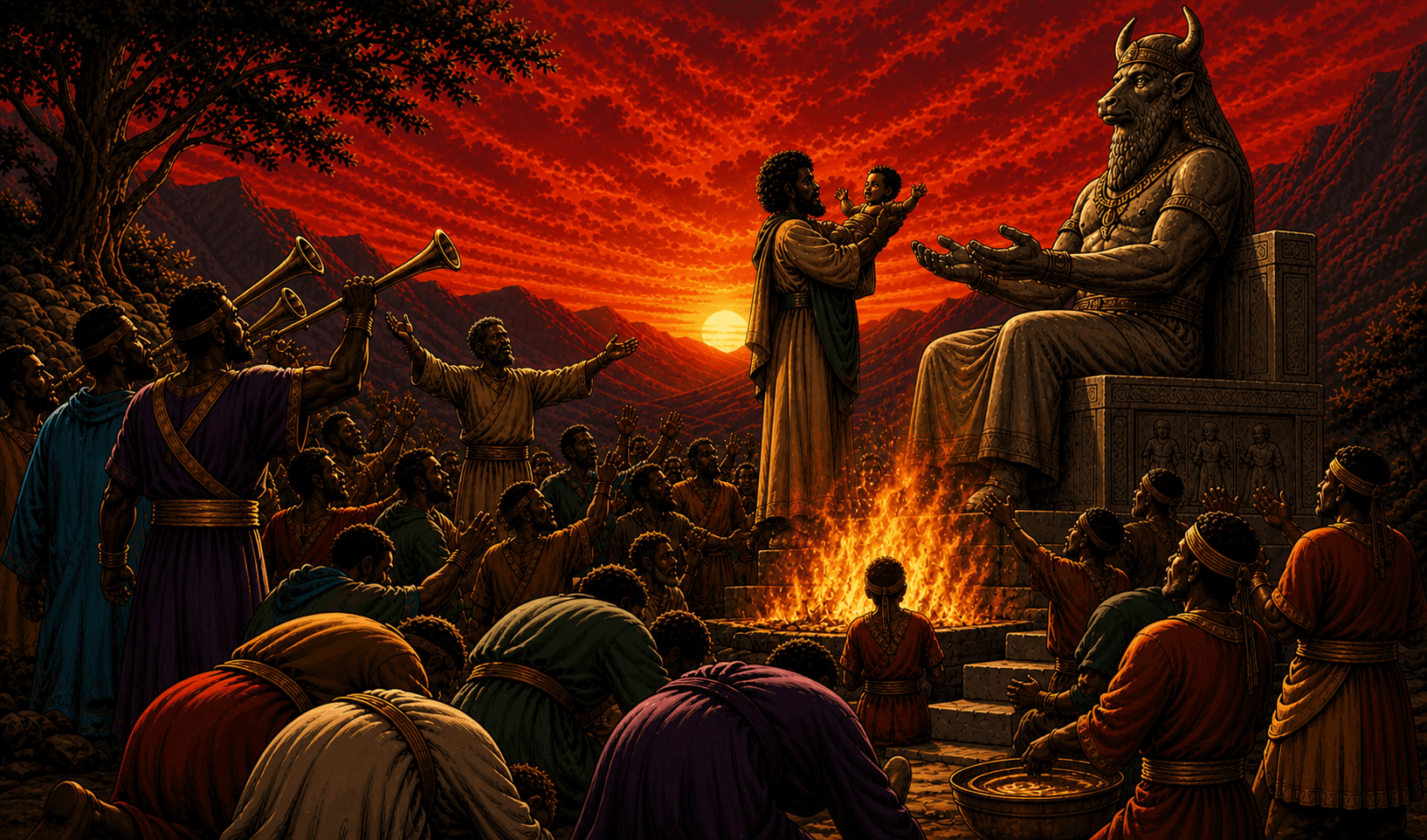
Every Pagan God Demands Blood
What do Baal, Molech, Chemosh, Dagon, and every pagan deity in the ancient world have in common?
They all demand blood sacrifice.
The worshippers of Baal cut themselves and poured blood on altars. The worshippers of Molech passed their children through fire. The priests of every nation around Israel killed animals — and sometimes people — to appease their gods.
Now ask yourself: if AO, the Most High God, is not like the gods of the nations — why does He supposedly require the same thing they do?
When Pharaoh offered to let Israel worship within Egypt, Aaron replied:
"It would not be right to do that because the
sacrificesofferings we offer to AO our God would be detestable to the Egyptians. If we offersacrificesofferings that are detestable before the Egyptians, will they not stone us?" — Exodus 8:26
Ask yourself: if Israel's worship involved blood sacrifice — the same blood sacrifice every Egyptian priest performed daily — why would the Egyptians find it detestable? They wouldn't. Blood on altars was the universal language of every pagan religion in the ancient world.
Whatever Israel's worship looked like, it was something the Egyptians could not tolerate. That alone tells you it was not blood sacrifice.
AO's Own Testimony
AO does not require blood sacrifice. And He says so plainly:
For I spoke not unto your fathers, nor commanded them in the day that I brought them out of the land of Egypt, concerning burnt offerings or sacrifices. — Jeremiah 7:22
Read that again. AO says: I did not command this. Not at Sinai. Not during the Exodus. Not ever.
King David confirms:
Sacrifice and offering You did not desire; my ears have You opened: burnt offering and sin offering have You not required. — Psalms 40:6
And Samuel declares:
Has AO as great delight in burnt offerings and sacrifices as in obeying the voice of AO? Behold, to obey is better than sacrifice, and to hearken than the fat of rams. — 1 Samuel 15:22
Three witnesses. The prophet, the Messiah, and the priest — all declaring the same truth: AO never commanded the sacrificial system.
So who did?
The Book That Was Inserted
If you have not read The Torah Has Three and a Half Books — Not Five, start there. The evidence is laid out in full. But here is the summary:
Open your Bible to the last verse of Exodus and the first verse of Numbers. Read them back to back:
For the cloud of AO was upon the tabernacle by day, and fire was on it by night, in the sight of all the house of Israel, throughout all their journeys. — Exodus 40:38
And AO spoke unto Moses in the wilderness of Sinai, in the tabernacle of the congregation, on the first day of the second month, in the second year after they were come out of the land of Egypt... — Numbers 1:1
The narrative flows like water. The tabernacle has just been erected. The very next moment, AO speaks from within it. There is no break, no shift in voice, no change of setting. Exodus walks directly into Numbers.
What is Leviticus doing between them?
Twenty-seven chapters of sacrificial law, priestly ordination, and blood ritual — wedged into a seam where they do not belong. Remove Leviticus, and the Torah reads as one unbroken story.
The book was inserted to establish a false priesthood under the tribe of Levi and to transform the Most High God into a blood-demanding deity — indistinguishable from Baal.
The Tribe That Shouldn't Exist
If Leviticus is an insertion, then the tribe assigned to administer it demands scrutiny. And when you examine Levi's place in the Torah, the cracks are impossible to ignore.
Levi is missing from the census. In Numbers 1:4–15, AO commands that one leader from each tribe be appointed to assist Moses in numbering Israel. Twelve tribes are named. Levi is not among them.
Levi is missing from the spies. In Numbers 13, AO expressly commands Moses to send one man from every tribe to scout the land of Canaan. Twelve spies are sent. No representative from Levi.
Levi receives no inheritance. When the land is divided among the tribes, Levi gets no territory. Every other tribe receives its portion. The Levites stationed in cities belonging to other tribes were there to serve — judging disputes and teaching the law so that not every matter had to be brought to Jerusalem (Deuteronomy 17:8, 2 Chronicles 19:5, 8). They were posted, not settled. But what about the members of the tribe who were not in service — those too young, too old, or otherwise unable to serve? They had no land. No cities. No inheritance. A tribe without a homeland is a tribe whose non-serving members are homeless.
And the language itself betrays the insertion. Judges 17:7 describes a "Levite" sojourning in Bethlehem-judah — but one cannot sojourn without a home to return to. Every sojourner in Scripture has a homeland elsewhere. Levi does not. Ephraim does. The true priesthood resolves the contradiction — the man in Judges 17:7 is not a Levite. He is an Ephraimite, sojourning away from his inheritance, exactly as the word requires.
The Torah itself treats Levi as outside the original tribal structure. Harvard scholar Idan Dershowitz, in his landmark work The Valediction of Moses, examined a proto-biblical text that predates the canonical Deuteronomy. In this earlier version, the tribal lists include Ephraim and Manasseh but exclude both Joseph and Levi entirely. The directional evolution of these texts supports the conclusion that the tribal scheme including Levi is a later development — one retrofitted onto an earlier system.
The twelve tribes of Israel, as originally constituted, did not include Levi. The tribe was written in to justify a priesthood that was written in to administer a sacrificial system that AO says He never commanded.
The Passover Lamb: A Full Breakdown
Now let us examine the crown jewel of the deception — the Passover sacrifice. Because if you follow the instructions as written in Exodus 12, you will violate the Torah.
Step 1 — Selecting the lamb on the Sabbath:
Speak to all the congregation of Israel, saying, in the tenth day of this month they shall take to them every man a lamb according to the house of their fathers, a lamb for a house. — Exodus 12:3
The tenth day of the first month always falls on the Sabbath. Yet the text commands Israel to go out and select a lamb — work that violates the Sabbath rest.
Step 2 — The blood in the basin:
And you shall take a bunch of hyssop and dip it in the blood that is in the basin, and strike the lintel and the two side posts with the blood that is in the basin. — Exodus 12:22
But where does the Torah command the blood to go?
Only you shall not eat the blood; you shall pour it upon the earth as water. — Deuteronomy 12:16
You shall not eat it; you shall pour it upon the earth as water. — Deuteronomy 12:24
The blood must be poured on the ground. Always. Every time an animal is slaughtered, the blood goes to the earth. Yet Exodus 12 has the blood collected in a basin and painted on doorposts — in direct contradiction to the Torah's own command.
Step 3 — The timing problem:
You kill the lamb at sunset on the Passover (Exodus 12:6, Deuteronomy 16:6). You must then bleed it out completely, salt it (as the Torah requires for all meat), and roast it whole — head, legs, and entrails (Exodus 12:9). All of this must be completed in time for a meal that same night, eaten in haste, with nothing remaining until morning (Exodus 12:10).
The logistics are impossible if you are properly draining and salting the animal as the Torah commands. But they work perfectly if you skip the blood laws entirely — which is exactly what this passage requires you to do.
Step 4 — The word "sacrifice" itself:
And you shall say, it is the sacrifice of AO's Passover, who passed over the houses of the children of Israel in Egypt. — Exodus 12:27
But AO just told us through Jeremiah: I did not command sacrifices in the day I brought them out of Egypt. The Passover is called a sacrifice in the very moment that Jeremiah says no sacrifice was commanded. One of these is a lie. And since AO does not lie, the corruption is in Exodus 12 — not in Jeremiah 7.
What the Passover Actually Is
The Passover is not a sacrifice. It is a memorial:
And this day shall be to you for a memorial, and you shall keep it a feast to AO throughout your generations. You shall keep it a feast by an ordinance forever. — Exodus 12:14
It commemorates the night AO brought the children of Israel out of Egypt with a mighty hand. The feast of unleavened bread — seven days without leaven — is the true command. And as we showed yesterday, the leaven is Leviticus itself — the corrupted priesthood that must be purged.
The blood on the doorposts was likely a scarlet thread — the same mark that protected Rahab's household when judgment fell on Jericho (Joshua 2:18). The parallels are exact: judgment is coming, mark your house, stay inside until morning, and the destroyer will pass over you. No altar. No priest. No blood sacrifice. Just a sign of obedience and trust in AO.
Why It Matters: Setting Up the Second Flame
Here is why this matters. The first flame of the twin flame deception is this: turn the Most High God into a deity who demands blood.
Once that lie is established — once Israel believes that AO requires blood to forgive, blood to protect, blood to atone — then the second flame can be lit. Because if God requires blood, then someone must ask: whose blood is sufficient?
And that is where the New Testament enters. That is where JC is presented as "the lamb of God who takes away the sin of the world." That is where Paul declares "without the shedding of blood there is no remission of sins" (Hebrews 9:22).
But the entire theology rests on the first flame. Remove Leviticus — remove the premise that AO ever wanted blood — and the New Testament has no foundation. JC dies for nothing. The cross means nothing. The entire Christian religion collapses.
The first flame is Levi. The second flame is Judah. One created the need for blood. The other claims to have supplied it.
Tomorrow we expose the second flame — how treacherous Judah (Jeremiah 3:11) replaced the true priesthood in the New Testament and presented the ultimate blood sacrifice through a lineage that was never meant to hold the throne.
This is Part 2 of the True Lineage of the Messiah series. Read Part 1: Ephraim Is My Helmet | Read the Strong Delusion series: Part 1: The Strong Delusion | Part 2: David or Jesus? | Part 3: Who Rose First from the Dead? | The Dawn of a New Day
Start with Welcome to the Torah of AO or read the Resurrection of King David for the Scriptural proof that David is the true Messiah.
Continue Reading

September 8, 2026
Serpentarius: Calling All Rebels of the House of AOshar'EL
The trumpet sounded this morning. Today is the first day of the seventh month, the Feast of Trumpets, the head of the year on AO's calendar. And on the day the shofar is blown, Part 1 of Serpentarius: Calling All Rebels of the House of AOshar'EL is released. Eighteen chapters that take apart the ephod, the sacrifices, the ark, the tabernacle, the altar, the blessing, the covenant of salt, the first temple, treacherous Judah, Cyrus, the second temple and the prophet like Moses, and put the staff back in the hand it belongs to. Chapters 19 through 22 are being held. What we have learned about 9/11/2029, the day AO arises from His Sabbath rest and Day 8 begins, required them to be rewritten. The full book arrives on the Eighth Day of the Feast of Tabernacles, the 22nd day of the 7th month, September 29, 2026 on Pharaoh's calendar. The new day is here. It is always darkest before the dawn. Know His Name and His Son's Name before the day breaks.
August 17, 2026
Supreme Peace
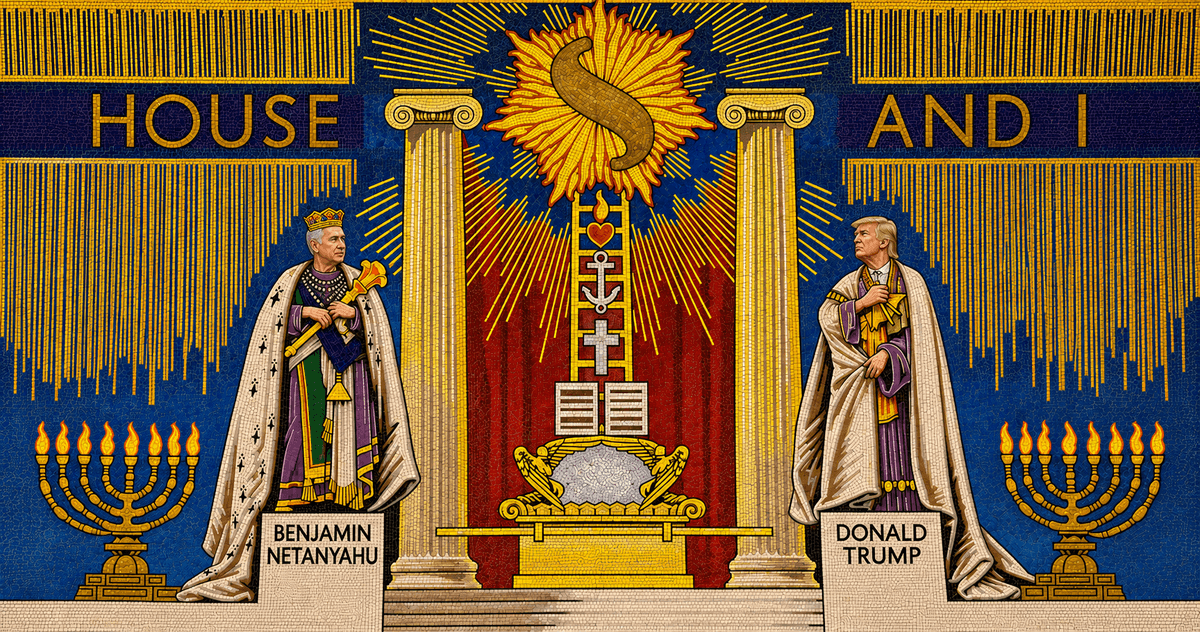
Supreme's FW26 preview released today — a jacket embroidered 'Supreme Peace' with an angel holding an AK-47 and a flower in the barrel — the same week the US–Iran peace deal is being finalized. August 24 is Kobe Bryant Day AND 2,402 days until the Second Exodus (Kobe #24, Gigi #2). Kobe Dodgers = Masonry = Nine Eleven = Blood Moon = 630 in English Gematria. Seventy-four days lands on November 5 — Guy Fawkes. 11 × 5 = 55 — the Five Points of Fellowship. Trump's Abraham Accords Truth Social capitalization = 4955 in Hebrew Gematria = 'You will have to wait for me to die for the destruction to begin.' Bibi Netanyahu — 'Long live BB' at the 11:05 mark of 1984 — may be the second witness of Revelation 11. The peace is the cue. The destruction is the payload.

June 14, 2026
Why The Builders Love 47
If it had been a snake, it would have bit me. We have been arguing 3/22 vs 4/4, AO's calendar vs Pharaoh's — and missed the builders' favorite number the whole time. 47. The United States was born on 7/4 (forty-seven reversed). And Monday, June 15, 2026 is 4/7 on AO's calendar — the day Adam fell, the day the flood opened, the number every Mason on earth is taught to honor. Sweet Caroline = Skull and Bones = Forty Seven = 149. The builders' BOOM lands on 4/7?
Discussion
Sign in or create a free account to join the discussion.
Loading comments…